IssueVolume 2, Issue 1 (2027)
Submission deadline31 January 2027
FeesNone. Open access, CC BY 4.0
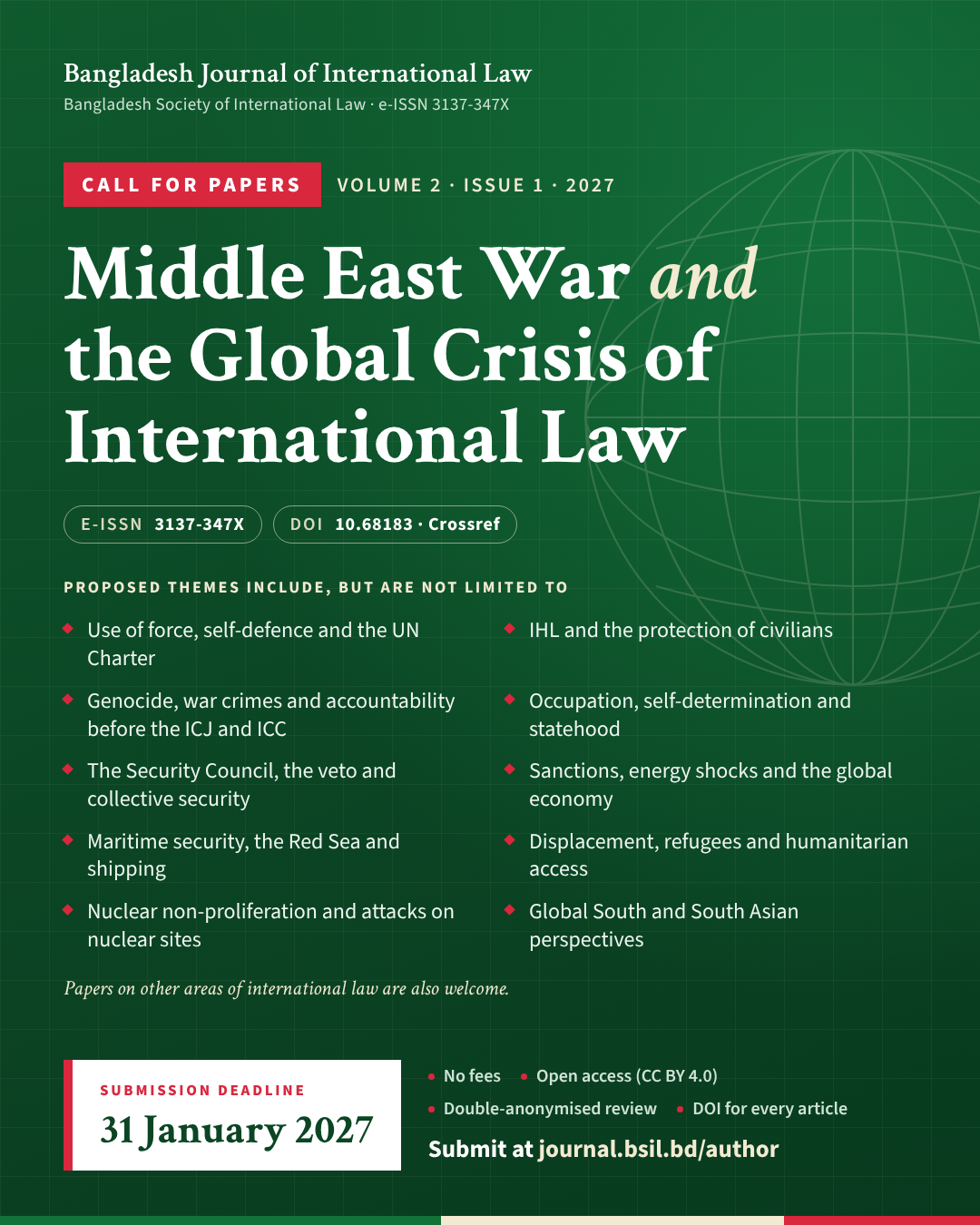
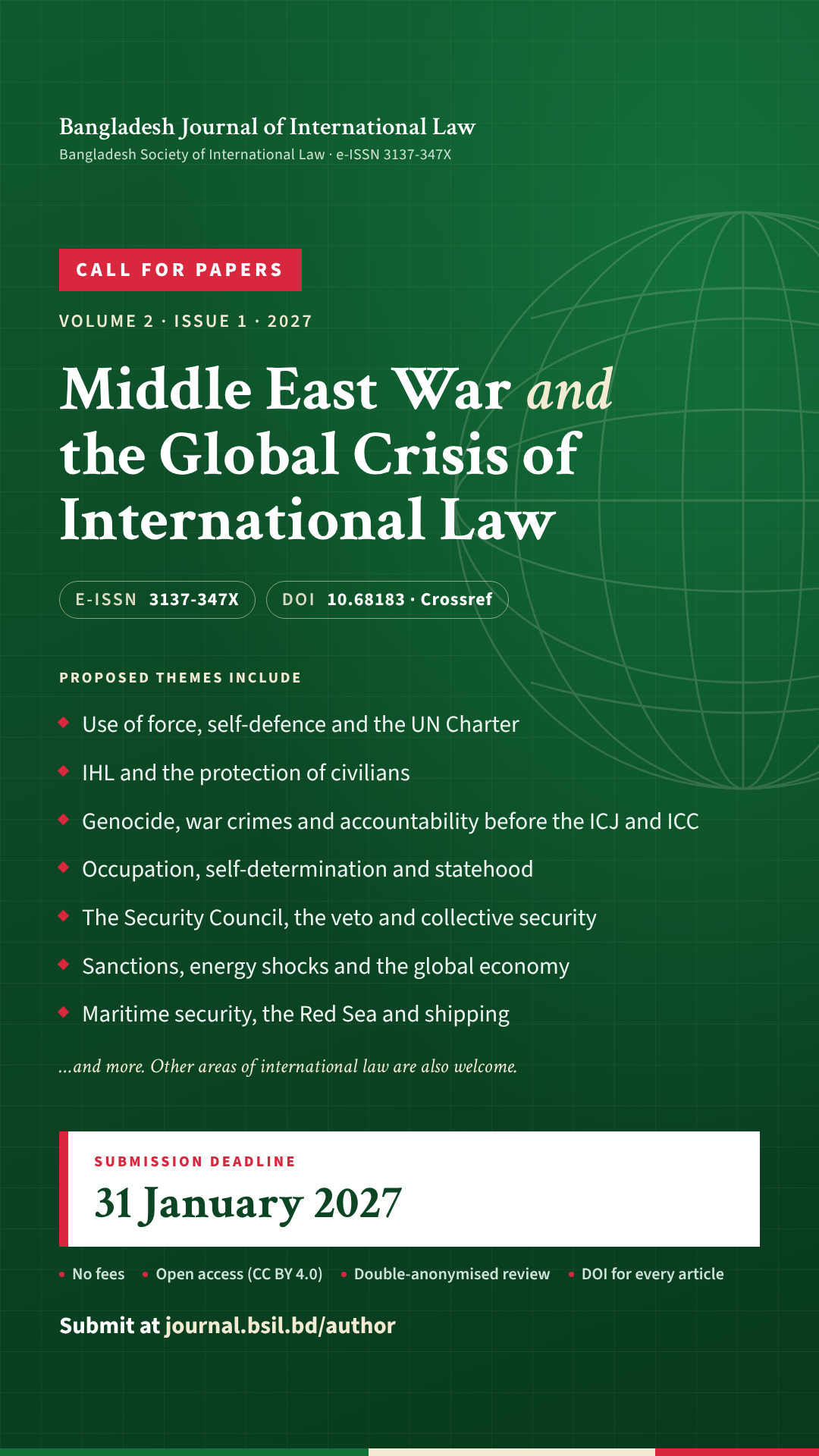
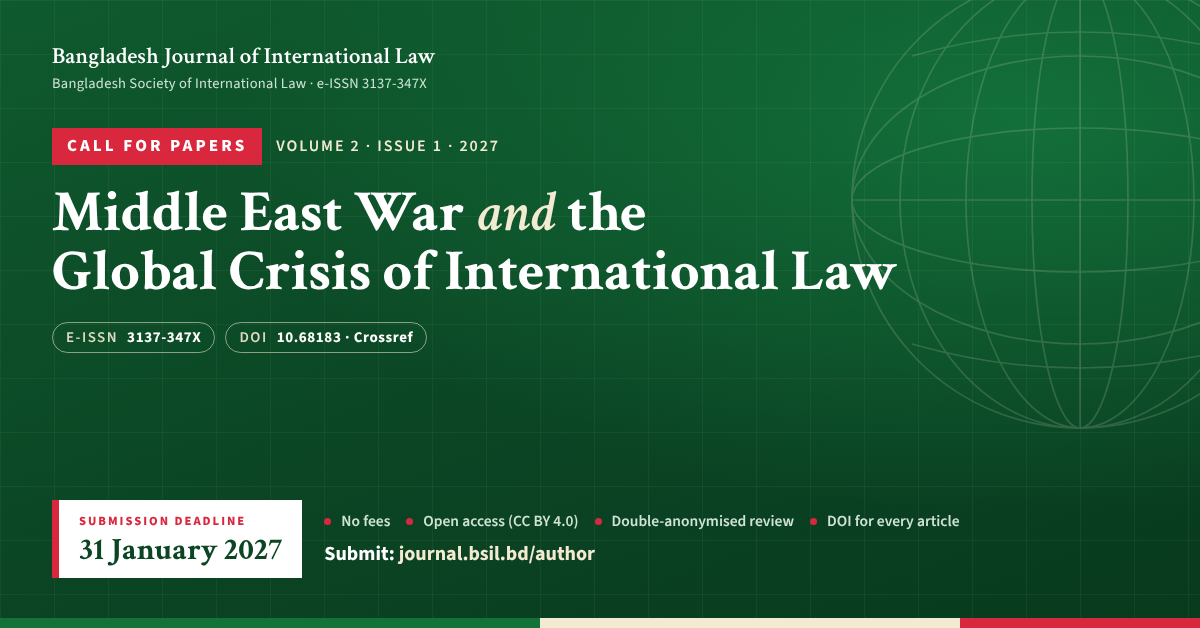
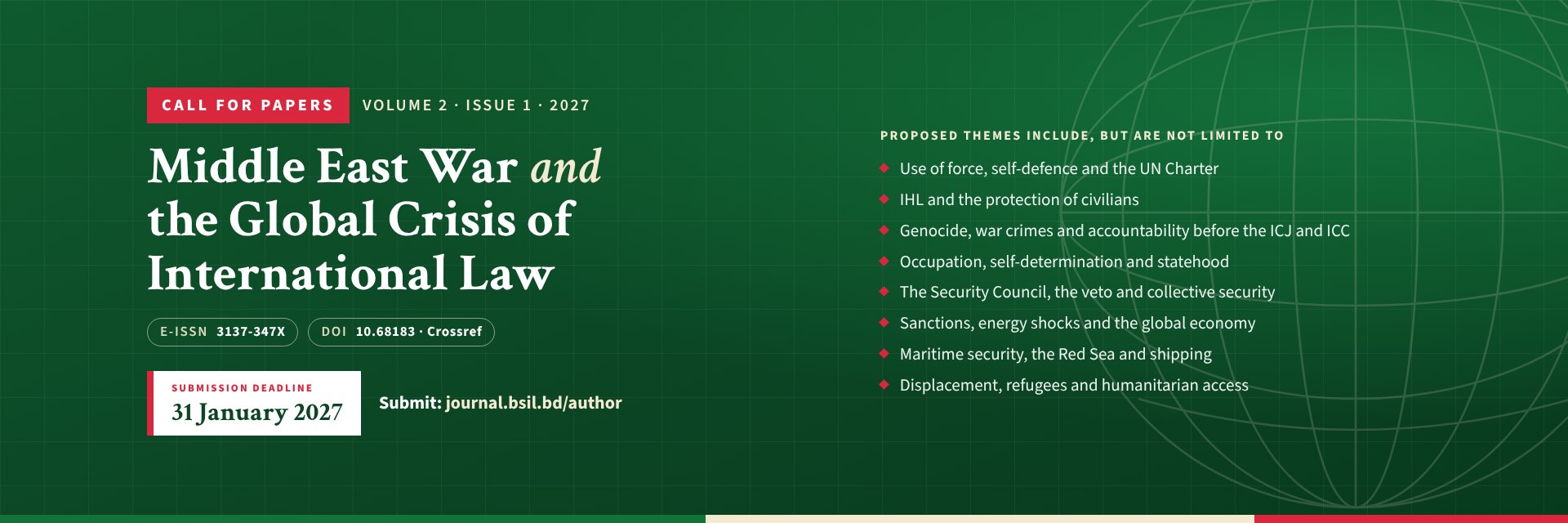
Middle East War and the Global Crisis of International Law
The Bangladesh Journal of International Law (BJIL), published by the Bangladesh Society of International Law (BSIL), invites submissions for Volume 2, Issue 1 (2027).
The wars and armed conflicts in the Middle East have put almost every part of international law under strain at the same time. Questions that once seemed settled are again open: when force may lawfully be used and how far self-defence extends; what international humanitarian law requires in densely populated areas; how genocide, war crimes and crimes against humanity are to be investigated and judged; what the law of occupation and the right of self-determination mean in practice; and whether the United Nations, and the Security Council in particular, can still deliver collective security.
The effects of these conflicts are not confined to the region. Attacks on shipping, sanctions, disruption of energy and food supply, mass displacement and the risk of nuclear escalation have turned a regional war into a global crisis, felt as far away as South Asia. At the same time, the International Court of Justice, the International Criminal Court, domestic courts and third states have been asked to act on obligations that many had treated as theoretical.
This issue asks what these events reveal about the state, and the future, of the international legal order. We welcome doctrinal, theoretical, historical, comparative and empirical work, and particularly encourage perspectives from Bangladesh, South Asia and the wider Global South, and from doctoral and early-career researchers.
Proposed themes
Submissions may address, but are not limited to, the following themes:
- Use of force and self-defenceThe UN Charter, anticipatory and pre-emptive self-defence, strikes against non-state actors and on the territory of other states.
- International humanitarian lawConduct of hostilities, proportionality and precautions, siege and starvation, and the protection of civilians, hospitals, journalists and aid workers.
- Genocide and atrocity crimesThe Genocide Convention, crimes against humanity and war crimes, and proceedings before the ICJ and the ICC.
- Accountability and justiceUniversal jurisdiction, commissions of inquiry, evidence and documentation, reparations and transitional justice.
- Occupation, self-determination and statehoodThe law of occupation, advisory opinions, recognition of states and the question of Palestine.
- The UN and collective securityThe Security Council and the veto, the General Assembly, peacekeeping and the reform debate.
- Obligations of third statesArms transfers, complicity, the duty to prevent genocide and to ensure respect for IHL, and corporate responsibility.
- Sanctions and economic measuresUN and unilateral sanctions, countermeasures, trade and investment disruption and their legality.
- Maritime security and the Red SeaFreedom of navigation, attacks on merchant shipping, naval operations and the law of the sea in armed conflict.
- Nuclear non-proliferationThe NPT and IAEA safeguards, attacks on nuclear facilities and the legality of counter-proliferation strikes.
- Displacement and humanitarian accessRefugees and internally displaced persons, forced transfer, humanitarian corridors and the role of UNRWA and other agencies.
- Energy, food and economic shocksGlobal supply disruption, the right to food, energy security and the legal response to cascading global crises.
- New technologies of warfareArtificial intelligence in targeting, autonomous weapons, drones, cyber operations and information warfare.
- Environment and armed conflictEnvironmental damage in war, protection of natural resources and the ILC principles on the environment in armed conflict.
- Global South and South Asian perspectivesBangladesh, South Asia and the Muslim world: foreign policy, migrant workers, energy dependence, and Third World approaches to international law.
- The future of the international legal orderSelectivity, double standards and the legitimacy of the “rules-based order”, and lessons for other conflicts and crises.
Submissions on other areas of public and private international law, outside the theme, are also welcome and will be considered for this or a later issue.
Key dates
| Stage | Date |
|---|
| Call for papers opens | 24 November 2026 |
| Deadline for full manuscripts | 31 January 2027 |
| First decision after double-anonymised peer review | Normally within 8–12 weeks of submission |
| Publication | Volume 2, Issue 1 (2027) |
Early submission is encouraged. Manuscripts are reviewed as they arrive, and accepted papers may be published online as Advance Articles before the issue is complete.
Types of contribution
| Type | Length (including footnotes and abstract) | Abstract |
|---|
| Original Research Articles | 8,000–12,000 words | 250–300 words |
| Short Articles | 6,000–7,000 words | 200 words |
| Case Notes and Commentaries | 2,000–3,000 words | 150 words |
| Book Reviews | 2,000–3,000 words | 150 words |
Case notes on recent decisions of the ICJ, the ICC and domestic courts, and reviews of recent books on the theme, are particularly welcome.
How to submit
- Read the Author Guidelines and Aims & Scope.
- Prepare a cover letter using the BJIL Cover Letter Template, and state that the paper responds to the Volume 2, Issue 1 (2027) call for papers.
- Prepare a separate title page and a fully anonymised manuscript in Microsoft Word: English (British spelling), 12-point Times New Roman, 1.5 line spacing, with footnotes in OSCOLA (5th edition).
- Submit all files through the BJIL Author Portal by 31 January 2027.
Manuscripts must be original, not previously published and not under consideration elsewhere.
Why publish with BJIL
- No fees. No submission, publication, page or colour charges.
- Open access. Published under a Creative Commons Attribution (CC BY 4.0) licence; authors keep their copyright.
- Rigorous review. Double-anonymised peer review, with decisions based solely on scholarly merit.
- Discoverable. Every item receives a Crossref DOI; e-ISSN 3137-347X.